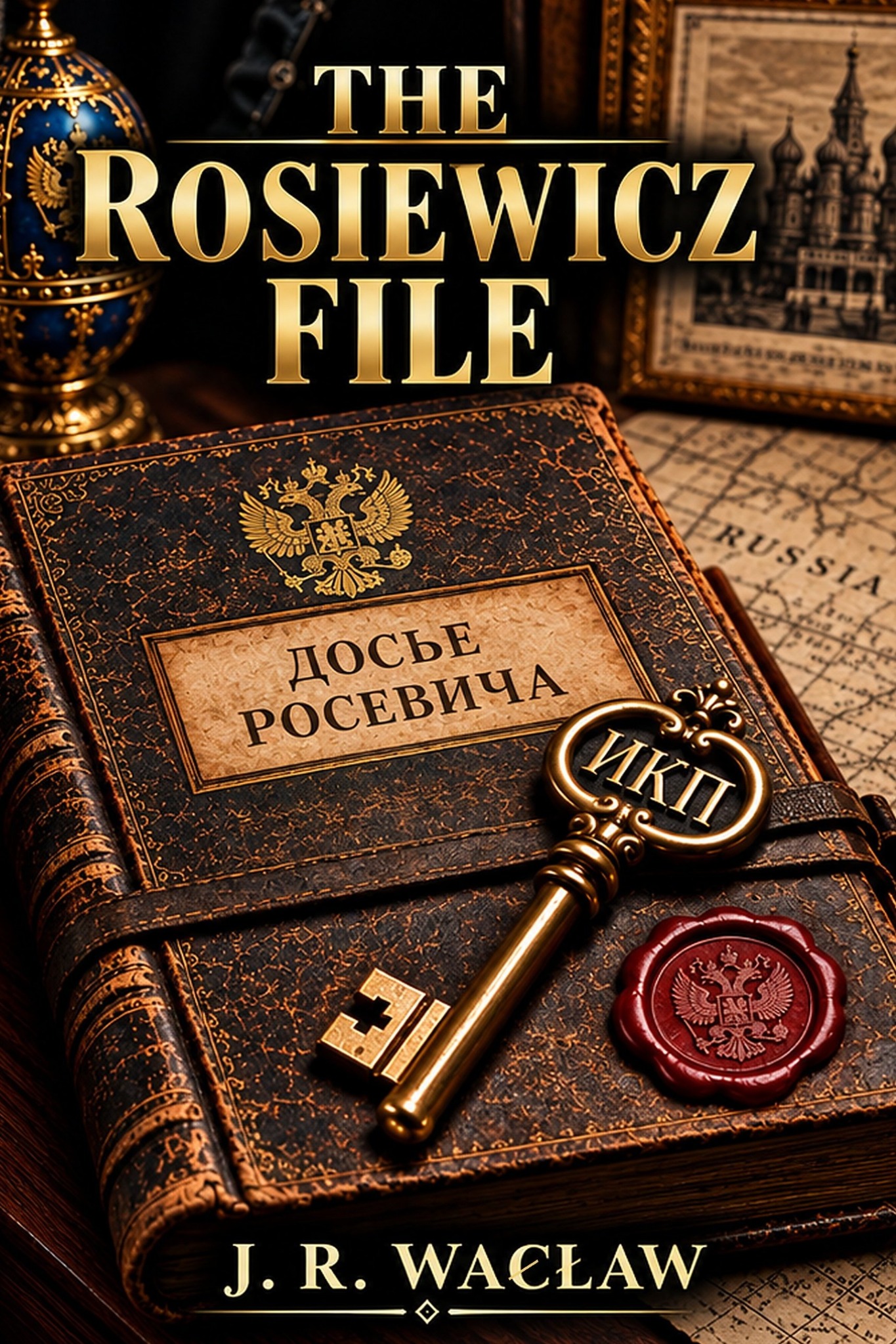
CHAPTER ONE
The First Shipment
Warsaw, Russian Poland — October 1904
The crate was seven pounds heavier than the manifest allowed.
Wacław Rosiewicz discovered the difference before dawn, while fog still pressed against the Vistula and the lamps along the government dock burned like weak yellow moons. He weighed every sensitive shipment twice—once for the Russian authorities and once for himself. The official scale said one hundred eighty-four pounds. His private scale, hidden behind stacked shipping sacks in the tally room, agreed.
By Imperial appointment, Wacław supervised sensitive government cargo moving through the Warsaw river facilities. No such consignment was loaded, unloaded, recorded, or released without passing through his office.
The paper fixed beneath the lid declared one hundred seventy-seven.
Seven pounds could be a clerk’s carelessness. Seven pounds could also hang a man.
Wacław rested one hand on the rough oak and listened. Beyond the warehouse wall, chains scraped over iron bollards. Horses stamped on frozen cobbles. Men called to one another in Polish, Russian, and German as they loaded casks of spirits and bundled timber onto a low river steamer. Farther downstream, where the Vistula widened toward the north, a whistle answered through the fog.
He lifted the lamp. The crate bore the black double-headed eagle of the Imperial household. Beneath it, almost lost in the grain of the wood, someone had pressed a second mark: a heron worked in silver ink, standing above three narrow waves.
The emblem belonged to Zofia’s family.
Lewandowski Brothers Distilling and Export did not place its mark on Imperial cargo.
Not officially.
A boot struck the threshold behind him.
“Captain Rosiewicz.” Major Orlov’s voice carried the unpleasant calm of a man who enjoyed arriving before he was expected. “You are here early.”
Wacław lowered the lamp but did not step away from the crate. “The river does not consult the clock, Major.”
Orlov entered with two soldiers. He was narrow through the shoulders and carefully groomed, with a waxed mustache that seemed too delicate for the rest of him. His gaze moved from Wacław to the scale and then to the Imperial seal.
“Nor, apparently, does the Emperor’s family.” Orlov tapped the manifest with one gloved finger. “What is inside?”
“Household property bound for inspection in Warsaw.”
“That is what the paper says.”
“Then your question has been answered.”
Men knew Wacław had unusual access to the Imperial household—enough to attract whispers, never enough to explain them. His mother, Antonina Rosiewicz, had served within Imperial circles when she was young. Most men were wise enough to let the story end there.
Orlov smiled. “You speak boldly for a man accused of receiving favors.”
“If I received favors, I would not be counting barrels before sunrise.”
“Perhaps this is the favor.” Orlov placed his palm upon the crate. “Perhaps no one else would be permitted to move Imperial property without naming its contents.”
Wacław met his eyes. “Break the seal if you possess written authority.”
The warehouse seemed to become quieter around them. Orlov did not have the authority. Opening a sealed Imperial consignment without an order could end his career as efficiently as any bullet. But refusing to open it would leave him with the suspicion that Wacław had known precisely what he was doing.
At last Orlov withdrew his hand. “Correct the weight.”
“I already intended to.”
“And delay the shipment?”
Wacław glanced toward the river. The shipment would depart within the hour. Once it entered the Lewandowski network, Jakub’s people would move it west under ordinary commercial papers, changing hands and records as necessary until it crossed the Atlantic. Months of preparation rested beneath Orlov’s glove, though the major could not have known it.
“No,” Wacław said. “The shipment leaves today.”
Orlov studied him for several seconds. “One day, Captain, your confidence will be mistaken for treason.”
“Only by a man who has already decided I am guilty.”
Orlov turned away. At the door he stopped. “Seven pounds,” he said without looking back. “An interesting error.”
Then he and the soldiers vanished into the fog.
Wacław waited until their footsteps had faded. Only then did he release the breath caught beneath his ribs.
From behind the stacked casks, a second man emerged. Jakub Lewandowski was broad-faced and heavy through the chest, with the stained hands of someone who had spent his life among barrels, copper coils, and leaking taps. He was Zofia’s older brother. By 1904 he was operating the well-established family export business built by the generation before him, and its trade in spirits had given him contacts far beyond Poland.
“You invited him to open it,” Jakub whispered.
“He could not.”
“And if he had?”
“We would both already be dead.”
Jakub crossed himself. “You say such things too easily.”
“I have had practice.”
Together they rolled the crate behind the rye sacks. Jakub removed a thin pry bar from beneath his coat. He worked four concealed pins from the lower molding, leaving the Imperial seal untouched. The false bottom dropped half an inch.
Inside lay a fitted metal box no larger than a bread loaf. Its dull surface gave no hint of what it protected. Around it were lead plates, cut precisely to defeat casual measurement and shield the contents from blows. One plate had shifted during the wagon journey. That was the extra weight reflected on Wacław’s scale but omitted from the official manifest.
Jakub pushed the plate back into its channel. “The next clerk may notice.”
“The next clerk will weigh the outer consignment after it has been joined to the spirits cargo. His manifest will show the correct total.”
“If every man does what he has been paid to do.”
“Not paid,” Wacław said. “Trusted.”
Jakub gave a humorless laugh. “Money is more reliable.”
“Money can be counted. Trust cannot.”
They secured the false bottom. Wacław then removed the original manifest and wrote a corrected figure on a replacement sheet. Nothing in the new document was false. That was one of the rules he had learned in his years of handling Imperial freight: never lie where an incomplete truth would serve.
A wagon from Lewandowski Brothers Distilling and Export waited in the service lane. Its oak casks carried the silver heron above three waves, a mark familiar to buyers and freight agents far beyond Poland. Spirits were the company’s principal trade, and generations of legitimate business had built a network of warehouses, wagoners, rail agents, exporters, merchants, and trusted intermediaries. Wacław needed that network now.
The Imperial crate was slid into a larger shipping case between two fitted rows of bottles. By the time the lid was nailed down, it had become ordinary commercial freight.
“We can get it west from here,” Jakub said. “After that I have three possibilities. I want to hear which one you trust.”
“Show me all three.”
“My company’s mark is on the case. I will know the route because I have to build it.”
“You will know what your people need to know,” Wacław said. “Nicholas will not.”
Jakub studied him. “And the final resting place?”
“You and I choose it. Once delivery is confirmed, I record it for Zofia.”
Jakub’s expression hardened. “Then we make certain there is something worth recording.”
Wacław looked toward the closed case. “This is only the beginning.”
Jakub waited, but Wacław offered nothing more.
The fewer words spoken beside an open crate, the better.
Jakub finally asked, “And you believe sending these things away will save anyone?”
“I believe leaving everything together will ensure it is taken.”
Jakub lowered his voice. “Taken by whom?”
“Whichever men are holding rifles when the government falls.”
The words remained between them. Beyond the wall, Russia appeared immovable: soldiers at the dock, portraits of the Emperor in government offices, taxes collected in his name, prayers offered for his health. Yet Wacław had read the intercepted manifests and the reports arriving from distant garrisons. He had watched officers sell supplies intended for their own men. He had seen hunger turn workers into crowds and crowds into something harder to control.
The Empire was not falling. Not yet.
But it had begun to lean.
(Continued in The Rosiewicz File, available now.)